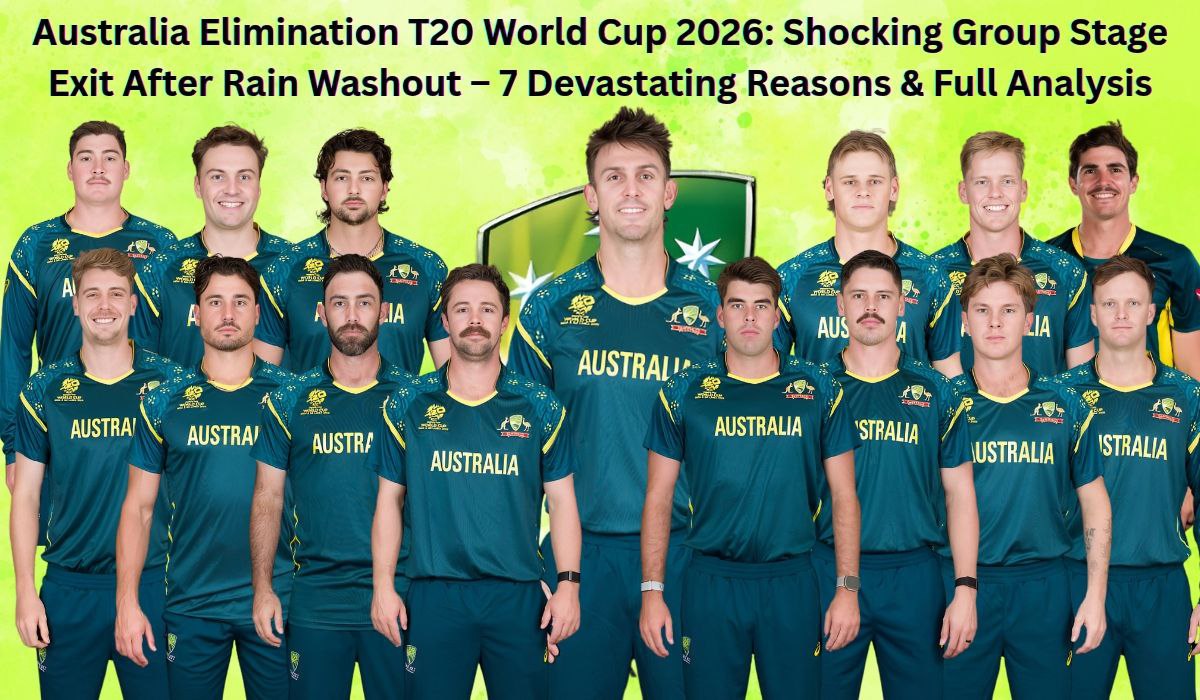
If you are an Australian cricket fan, today hurts. On February 17, 2026, grey skies over Pallekele International Cricket Stadium in Kandy, Sri Lanka, ended Australia’s hopes in the ICC Men’s T20 World Cup 2026. No ball was bowled in the Zimbabwe vs Ireland match. One precious point went to Zimbabwe. That single point knocked the 2021 champions out of the tournament in the group stage.
Australia elimination T20 World Cup 2026 is now official. It is only the second time in 10 editions that the most successful ICC nation has failed to reach the Super 8. The last time? 2009.
This long-form report from IPL Star breaks down every moment, every mistake, and every lesson. We use simple words so every cricket lover – from die-hard Aussies to neutral fans – can understand what went wrong and what comes next.
Group B Results Table – Australia’s Campaign at a Glance
| Date | Opponent | Result | Key Highlight |
|---|---|---|---|
| Feb 11, 2026 | Ireland | Won by 67 runs | Nathan Ellis Player of the Match |
| Feb 13, 2026 | Zimbabwe | Lost by 23 runs | Shock defeat on slow pitch |
| Feb 16, 2026 | Sri Lanka | Lost by 8 wickets | Collapsed from 0-104 to 181 all out |
| Feb 20, 2026 | Oman | Upcoming (dead rubber) | No impact on qualification |
Australia finished with just 2 points. They needed Ireland to beat Zimbabwe. Rain said no.
The Fate-Sealing Washout – Minute by Minute (February 17, 2026)
Scheduled start: 3:00 PM local time (Pallekele).
Rain started mid-morning. Grey clouds hung heavy.
Ground staff pulled covers at 3:55 PM and worked 90 minutes removing surface water.
Skies darkened again at 5:00 PM.
Match officially abandoned at 5:30 PM local (11:00 PM AEDT).
Zimbabwe got 1 point – exactly what they needed to top Group B alongside Sri Lanka.
Zimbabwe captain Sikandar Raza later said: “Super Eight is a tick in the box, but we have bigger goals.”
Australian players watched from their hotel 10 km away. Captain Mitchell Marsh called it “tournament cricket – sometimes the lap of the gods.”
Why Australia Out of T20 World Cup 2026 – The 7 Devastating Reasons
1. Bowling Crisis – No Cummins, No Hazlewood, No Starc
Australia walked into the tournament without their three best pace bowlers.
- Pat Cummins: Back injury ruled him out.
- Josh Hazlewood: Hamstring injury in November 2025 kept him sidelined.
- Mitchell Starc: Retired from T20Is before the tournament.
Without their “banana swing” and death-over control, Australia leaked runs in the powerplay and middle overs. Against Zimbabwe, they could take only a handful of wickets. Against Sri Lanka, the spin-heavy attack exposed the same weakness.
Pace Attack Comparison Table (2021 WC vs 2026 WC)
| Year | Key Pacers | Powerplay Wickets | Economy Rate |
|---|---|---|---|
| 2021 | Starc, Cummins, Hazlewood | 18 | 7.2 |
| 2026 | Ellis, Green, Stoinis | 6 | 9.1 |
The gap is massive.
2. Middle-Order Collapses on Slow Sri Lankan Pitches
Australia started brilliantly twice but crumbled.
Vs Sri Lanka: Marsh and Travis Head put on 104 runs in 9 overs. Then six wickets fell for 21 runs. Final score: 181 all out. Pathum Nissanka smashed 100* off 52 balls to chase it comfortably.
The team relied too much on power-hitters (Maxwell, Stoinis, Head) and lacked “anchors” like Steve Smith, who was surprisingly left out.
3. Selection Blunders and Part-Timer Experiment
Experts like Ian Healy and Mark Waugh slammed the squad balance.
Part-timers (Stoinis, Maxwell, Connolly) were asked to bowl death overs. They leaked 12+ runs per over.
Benching experienced seam options for “power” players backfired on slow tracks.
4. Preparation Problems – BBL Over Warm-Ups
Key players played Big Bash League finals instead of a proper warm-up series in Pakistan.
Result? They looked rusty against spin and variable bounce in Colombo and Kandy.
5. T20 Format Deprioritised in Australia
Many pundits say Australia treats T20 as the “third format”. Test and ODI cricket get priority. With a home T20 World Cup in 2028, this mindset must change.
6. Injury Luck and Squad Depth
The campaign was “doomed from the get-go” according to Mark Waugh. One hamstring here, one back injury there – and suddenly the world’s No.2 ranked side had no answers.
7. The Rain Factor – Out of Their Control
Even if Australia had won all games, the washout took qualification out of their hands. But their earlier losses made it possible.
Match-by-Match Deep Dive
Feb 11 vs Ireland – Comfortable Win
Australia posted 200+ and restricted Ireland to 133. Nathan Ellis took crucial wickets. Good start, but warning signs in middle overs.
Feb 13 vs Zimbabwe – The Shock Loss
On a slow Premadasa pitch, Australia posted 160-ish. Zimbabwe chased with 39 balls to spare. Blessing Muzarabani’s 4/17 was the best bowling spell by a Zimbabwean in T20 World Cup history. Zimbabwe showed perfect batting construction.
Feb 16 vs Sri Lanka – The Killer Defeat
Opening stand 104. Then total collapse. Sri Lanka chased 182 with 8 wickets and plenty of overs to spare. Nissanka’s century on a difficult pitch was masterclass.
Feb 20 vs Oman – Dead Rubber
The match at Pallekele (7:00 PM IST) changes nothing. Australia will play for pride.
For more ESPNcricinfo.
Zimbabwe’s Cinderella Story – History Made
Zimbabwe missed the 2024 T20 World Cup after losing to Uganda and Namibia in qualifiers.
In 2026 they beat Oman by 8 wickets and Australia by 23 runs.
Now they join India, West Indies and South Africa in Super 8 Group 1.
This is their best men’s T20 World Cup finish ever – better than their bottom place in 2022 Super 12.
Captain Raza: “We didn’t set a goal just to qualify. We have other goals.”
Historical Context – Australia’s T20 World Cup Record
T20 World Cup Performances Table
| Year | Stage Reached | Key Reason for Exit |
|---|---|---|
| 2009 | Group Stage | Losses to WI & SL |
| 2022 | Super 12 (hosts) | Narrow net run-rate miss |
| 2024 | Super 8 | Losses to India & Afghanistan |
| 2026 | Group Stage | Losses to Zim & SL + rain washout |
Only 2009 matches this pain. Australia have won 6 ODI World Cups, 2 Champions Trophies, 1 T20 World Cup (2021) and 1 WTC. This exit stings because it exposes a transition phase.
Reactions from Around the World
Mitchell Marsh: “We had a good platform but just weren’t able to execute… we were outplayed.”
Mark Waugh: “The non-selection of Steve Smith is the most baffling I can remember.”
Ian Healy criticised part-timer bowling experiments.
On social media, Aussie fans called it “karma” after the 2023 ODI trophy celebration controversy, but the real issues are structural.
Lessons for 2028 T20 World Cup (Co-Hosted by Australia)
Australia must act now. Here are 12 clear, actionable steps:
- Rebuild pace depth with young quicks.
- Bring back anchor batters like Smith for sub-continent conditions.
- Schedule proper T20-specific warm-ups.
- Reduce BBL overload before major tournaments.
- Develop specialist death bowlers.
- Balance power-hitting with technique on slow pitches.
- Integrate Cooper Connolly earlier in high-pressure games.
- Review selection committee processes.
- Invest in spin options for Asian conditions.
- Prioritise T20 in the national calendar.
- Use data analytics for pitch-specific strategies.
- Build mental toughness for “must-win” group games.
Upcoming Fixtures for Australia After This Exit
| Month | Series | Format |
|---|---|---|
| June 2026 | Pakistan (away) | 3 ODIs |
| June-July 2026 | Bangladesh (away) | 3 ODIs + 3 T20Is |
| August 2026 | Bangladesh (home) | Tests (Darwin/Mackay) |
| Sept-Oct 2026 | South Africa (away) | 3 Tests + 3 ODIs |
| Nov-Dec 2026 | England (home) | White-ball series |
| Dec 2026-Jan 2027 | New Zealand (home) | 4 Tests |
What This Means for IPL Stars and Australian Cricket
Players like Glenn Maxwell, Travis Head, Marcus Stoinis and Mitchell Marsh will return to IPL 2026 franchises with big questions to answer. Their domestic form in BBL helped them, but international T20 needs more. Cricket Australia must protect these stars from burnout while rebuilding the bench.
Young guns like Cooper Connolly and emerging pacers now get the chance to prove themselves before the 2028 home World Cup.
Final Thoughts – A Wake-Up Call, Not the End
Australia elimination T20 World Cup 2026 feels like rock bottom. But Australian cricket has bounced back from worse. Remember 2009? They rebuilt and won the 2015 ODI World Cup on home soil.
The 2028 T20 World Cup is coming to Australia. This pain can become fuel. Fix the depth, fix the preparation, fix the mindset – and the golden generation of 2028 can shine.
If you are an Aussie fan reading this, drop your thoughts in the comments: Will Australia win the 2028 T20 World Cup on home soil? Which player should come back first – Steve Smith or a new pace leader?
At IPL Star we will keep bringing you honest, fan-friendly cricket news. From Australia elimination T20 World Cup 2026 analysis to every IPL 2026 update – we have you covered.
Stay tuned. The journey continues.
FAQs: Australia Elimination T20 World Cup 2026
1. What caused the Australia elimination T20 World Cup 2026? Australia elimination T20 World Cup 2026 was sealed by shock losses to Zimbabwe (23 runs) and Sri Lanka (8 wickets), plus the Zimbabwe-Ireland rain washout on 17 February 2026 that gave Zimbabwe the vital point. Injuries to Pat Cummins and Josh Hazlewood, Starc’s T20 retirement, and middle-order collapses turned a No.2 ranked side into group-stage exits for only the second time ever.
2. How did the Zimbabwe Ireland washout Australia 2026 decide the fate? The Zimbabwe Ireland washout Australia 2026 at Pallekele (abandoned 5:30pm local) awarded Zimbabwe one point — exactly what they needed to top Group B. Australia, watching from their hotel 10 km away, saw their only qualification path vanish. This long-tail event made the dead-rubber vs Oman irrelevant.
3. What were the Australia T20 WC 2026 results and key moments? Australia T20 WC 2026 results: Won Ireland by 67 runs (11 Feb), lost Zimbabwe by 23 runs (13 Feb), lost Sri Lanka by 8 wickets (16 Feb). The Sri Lanka match saw a 104-run opening stand collapse to 181 all out; Nissanka’s 100* sealed it.
4. Why Australia out of T20 World Cup 2026 – was it only the rain? Why Australia out of T20 World Cup 2026 goes far beyond rain. Tactical blunders, power-hitting over stability, part-timer bowling experiments, and BBL-prioritised preparation left them vulnerable on slow Sri Lankan pitches. The washout was the final blow after earlier defeats.
5. What was Mitchell Marsh reaction 2026 to the elimination? Mitchell Marsh reaction 2026 was honest: “We had a good platform but just weren’t able to execute… we were outplayed.” He refused to blame individuals, calling it classic tournament cricket after the Sri Lanka thrashing.
6. How bad is the Australia cricket crisis 2026 after this exit? The Australia cricket crisis 2026 is real — only the second group-stage exit in 10 T20 World Cups (after 2009). With no frontline pace attack and an aging middle order, this is the worst white-ball result since the 2023 ODI win, forcing urgent rebuild before 2028 home event.
7. What is the T20 World Cup 2026 group stage exit meaning for Australia? T20 World Cup 2026 group stage exit means Australia miss Super 8 for the first time since 2009. Zimbabwe took their seeded spot and will face India, West Indies and South Africa. Australia now play dead-rubber vs Oman on 20 Feb before white-ball tours of Pakistan and Bangladesh.
8. Did Steve Smith omission contribute to Australia elimination T20 World Cup 2026? Yes — experts slammed the Steve Smith omission as baffling. His anchoring could have prevented the repeated middle-order collapses (e.g., 6 wickets for 21 vs Sri Lanka) on subcontinental tracks that power-hitters alone couldn’t handle.
9. How does Zimbabwe’s qualification highlight the Australia elimination T20 World Cup 2026? Zimbabwe’s Cinderella run — beating Oman and Australia, then qualifying via washout — makes the Australia elimination T20 World Cup 2026 even more painful. It marks their best T20 World Cup finish ever, while exposing Australia’s transition struggles.
10. What lessons from Australia elimination T20 World Cup 2026 for 2028? Key lessons: rebuild pace depth, balance power with anchors, schedule T20-specific warm-ups, reduce BBL overload, and prioritise format. Australia’s 2028 home co-hosting gives perfect redemption window if these fixes happen now.